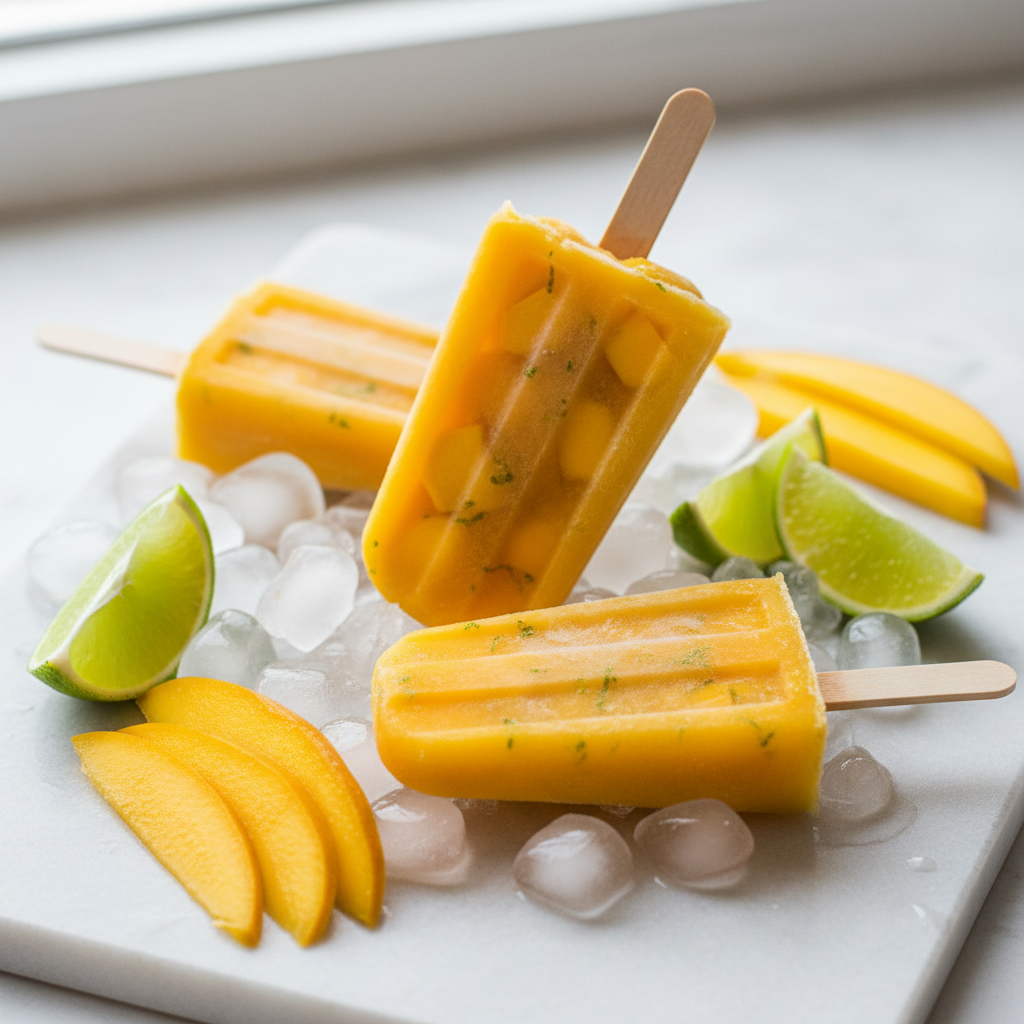
Mango-Lime Paletas
EasySafe for youdessertdairy-free

Mango-Lime Paletas

Paletas de mango con chile y limón — Mexico's beloved street frozen fruit bars made at home. Fresh Ataulfo or Champagne mangoes blended with fresh lime juice, a pinch of salt, and a touch of tajín or chilli powder for the classic sweet-tart-spicy balance that makes Mexican paletas unlike any other frozen dessert. Pure fruit, no dairy, no refined sugar beyond what the mango brings naturally.

15 minPrep
0 minCook
15 min active + 6 hrs freezingTotal
8Serves
Cooking progress0/4 steps

How to cook

Plating & presentation

Paletas are street food and they look best with that directness — no fussy plating, just the vivid golden-orange of the mango against a clean surface. Arrange two or three unmoulded paletas on a bed of crushed ice on a wide, flat board or a shallow tray — the crushed ice keeps them cold and slows melting, and the contrast of the golden paletas against the white ice is visually striking. A dusting of tajín over the surface of each paleta gives them a fine reddish-orange coating that signals the chilli-lime seasoning and adds colour contrast. Fresh lime wedges scattered around the board. A small bowl of extra tajín on the side for those who want more. The visible chunks of diced mango inside the paleta — if you included them — are visible through the slightly translucent frozen surface and add to the visual appeal. Serve immediately; paletas wait for no one.

Dana's tip

The single most important variable in a mango paleta is the quality and ripeness of the mango — everything else is secondary. An underripe, flavourless mango produces a flat, disappointing paleta no matter how much lime juice or sweetener you add. Ataulfo (Champagne) mangoes are the gold standard for paletas: they are fibreless, intensely sweet, and have a deep, complex mango flavour that survives freezing better than any other variety. Buy them when they are very ripe — the skin should be wrinkled and golden-yellow, not smooth and green, and the mango should smell intensely fruity at the stem end. The second critical point is seasoning for the frozen state: frozen desserts taste less sweet and less acidic than the same mixture at room temperature, because cold suppresses flavour perception. The blended mixture should taste slightly more intense, slightly more acidic, and slightly more seasoned than you want the finished paleta to taste — it will mellow and round out as it freezes. This is why the lime juice, the salt, and the taste-and-adjust step before pouring into moulds are all non-negotiable. The tajín is not decoration — it is the defining finishing touch of a Mexican mango paleta and the element that makes it taste distinctly Mexican rather than just a frozen mango bar. Do not skip it. If you cannot find tajín, the combination of mild chilli powder, salt, and a little citric acid or extra lime zest is a reasonable substitute, but the real thing is worth seeking out.

Ingredients

Serves 8
Ripe Ataulfo (Champagne) mangoes — the small, kidney-shaped yellow mangoes that are fibreless, intensely sweet, and deeply flavoured; they are the best mango for paletas by a significant margin; their flesh is smooth, dense, and almost custard-like when blended, with no stringiness; if Ataulfo mangoes are unavailable, use the ripest, most fragrant mangoes you can find — Alphonso, Kesar, or any variety that smells intensely of mango at the stem end; avoid Tommy Atkins or Kent mangoes, which are watery and flavourless by comparison; you need approximately 800g of peeled, pitted mango flesh from 4–5 Ataulfo mangoes4–5 Ataulfo mangoes (approx. 800g flesh)
Fresh lime juice — from 3 limes; freshly squeezed only; the lime does two things — it brightens and sharpens the mango flavour, and its acidity prevents the paletas from tasting flat and one-dimensional after freezing; frozen desserts need more acid than room-temperature ones because cold dulls flavour perceptionJuice of 3 limes
Fresh lime zest — from 2 of the limes; the zest contains the aromatic oils that give lime its distinctive fragrance; it adds a floral, citrusy top note that juice alone cannot provide; zest the limes before juicing themZest of 2 limes
Agave syrup or honey — to sweeten if needed; the amount depends entirely on the ripeness and natural sweetness of your mangoes; taste the blended mixture before adding any sweetener; a perfectly ripe Ataulfo mango may need none at all; agave keeps the paletas vegan; honey is equally good if that is not a concern; do not over-sweeten — the paleta should taste of mango first, with the sweetness in the background1–3 tbsp (to taste)
Fine sea salt — a small pinch; salt is not optional in a fruit paleta; it suppresses bitterness, amplifies sweetness, and makes the mango flavour more vivid and three-dimensional; the paleta should not taste salty — the salt should be completely imperceptible as saltA generous pinch
Cold water — a small amount to help the blender run smoothly if the mango is very dense; add only as much as needed; too much water dilutes the flavour2–4 tbsp if needed
Tajín Clásico seasoning — the iconic Mexican chilli-lime-salt powder that is the traditional finishing seasoning for mango paletas; it is sprinkled over the outside of the unmoulded paleta just before serving; it provides the sweet-tart-spicy contrast that is the defining character of a Mexican mango paleta; available in most supermarkets and online; if unavailable, substitute with a mixture of mild chilli powder, a pinch of salt, and a tiny pinch of citric acid or extra lime zestTo finish (optional but traditional)
Diced fresh mango — a small amount of the mango flesh cut into 5mm dice rather than blended; stirred into the mixture before pouring into moulds to create visible chunks of fruit in the finished paleta; optional but adds texture and visual appeal100g (optional)
Add intolerances on the homepage to highlight safe ingredients.
Back to Mexican